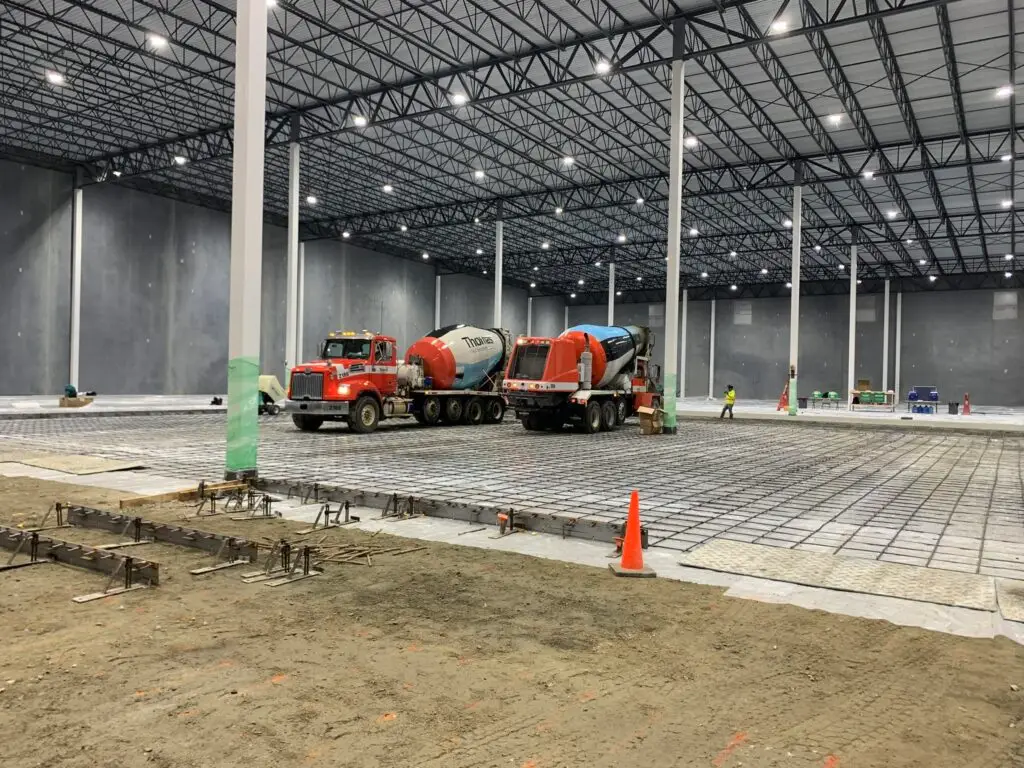
Data center development in the U.S. is accelerating in response to rapidly growing demand for capacity for AI, cloud services, and digital data storage. The U.S. currently accounts for approximately 90 percent of all data center capacity in the Americas, and investment is expected to remain at a high level in the coming years.*
According to international real estate and investment services company Jones Lang LaSalle (JLL), nearly 100 GW of new data center capacity is expected to be added globally between 2026 and 2030. The Americas are already the world’s largest data center region and JLL also expects the region to see the fastest growth through 2030.
“Data centers are reshaping the construction market by combining large scale, fast-paced execution and extremely high demands for precision. For us as a concrete supplier, this development presents significant opportunities, but it also places high demands on planning, consistent quality, and execution,” says Ryan Chandley, CEO at Thomas Concrete in the U.S.
Southeastern U.S. Growing as a Data Center Market
This development is particularly relevant to Thomas Concrete Group, as a significant share of the company’s U.S. operations is located in the Southeast. Atlanta is already an established data center market, while demand is also increasing in North Carolina and other parts of the Southern U.S.
To date, Thomas Concrete has supplied more than 150 000 cubic meters of concrete to more than 20 data halls across the U.S. A single large data center can require approximately 19 000 cubic meters of concrete, while a larger data center campus comprising several buildings can require more than 38 000 cubic meters. Concrete is used for foundations, floors, wall systems, electrical infrastructure, access roads, and other parts of the facilities.
Data centers differ from many other major construction projects in that the requirements go far beyond volume. Data halls are concrete-intensive structures designed to support large amounts of heavy and sensitive technical equipment, while floors and structures must meet stringent requirements for strength, flatness, durability, vibration control, and fire resistance.
Large data center campuses with multiple data halls, can also involve extensive concrete pours within short timeframes. This places particular demands on logistics, reliable deliveries, and coordination between the concrete supplier and the contractor.
“Data centers are not simply projects that require large volumes of concrete. They are complex projects where deliveries must be executed with a very high degree of precision and where early planning and close collaboration with the customer are critical. This aligns well with the expertise and delivery capabilities we have built across our U.S. markets,” says Ryan Chandley.
Demand Expected to Remain Strong
For Thomas Concrete Group, continued data center development represents an attractive growth opportunity in the U.S. market.
At the same time, development is becoming increasingly selective. Limited access to power, grid capacity, permitting processes, and land availability are playing a growing role in determining where and when new data centers can be built. As a result, investment is likely to become increasingly concentrated in markets that can offer the right combination of energy, infrastructure, and construction capacity.
“The outlook for data center construction remains strong, particularly in markets where land, power, and infrastructure can support continued expansion. In the Southeast, we see significant opportunities for Thomas Concrete to manage large and complex projects while delivering with a high degree of reliability,” says Ryan Chandley.
Source:
* 2026 Market Outlook for Global Data Centers | JLL Research