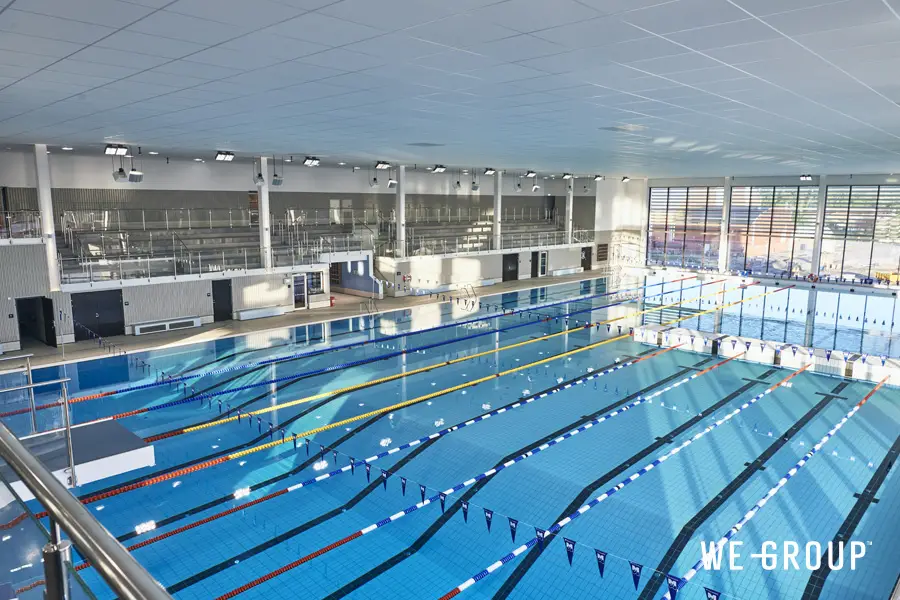
Swimming pool facilities present a demanding environment for concrete. High temperatures, humidity and chlorides from pool water affect the structure and can, over time, cause damage to components such as the reinforcement. At the same time, today’s general exposure classes for concrete do not always fully account for the specific conditions found in swimming pool environments.
“Swimming pool facilities are unique environments. They are warm and humid around the clock, all year round. Particularly in more complex swimming facilities and water parks, it can be difficult at the design stage to define exactly what the concrete needs to withstand. We see a need for clearer and more practical tools to facilitate this,” says Anders Lindvall, Concrete Technology Specialist at C-lab.
The right concrete in the right place
A swimming pool facility has an expected service life of around 50 years, but there are several examples where damage has resulted in extensive repairs much earlier. Conditions may also change over the lifetime of the building, for example through new water treatment technologies, chemicals or uses. The structure needs to be able to accommodate such changes.
In the new study, C-lab and NCC will investigate which performance requirements need to be specified for the concrete to reduce the risk of premature damage. The aim is to develop a practical tool that contractors can use during the design process and that concrete suppliers can then use as a basis for developing concrete tailored to the specific environment.
“We often talk about using the right concrete in the right place, and that is exactly what this project is about. The aim is to make it easier for contractors, clients and designers to specify the right requirements from the outset, and for concrete suppliers to use these requirements to develop and verify concrete that can withstand the specific environment,” says Anders Lindvall.
Gathering knowledge from across the industry
The study is being carried out by C-lab together with NCC. C-lab is responsible for a literature review, while experience and expertise will also be gathered through a broad reference group comprising representatives from material manufacturers, contractors and academia. The findings will then form the basis for developing relevant performance requirements for concrete used in swimming pool facilities.
“If we become better at specifying the right requirements already at the design stage, we can reduce the risk of extensive repairs being required much earlier than expected. Ultimately, it is about building swimming pool facilities that last for as long as they are intended to,” says Anders Lindvall.
The results of the study are expected to be presented during the first quarter of 2027.