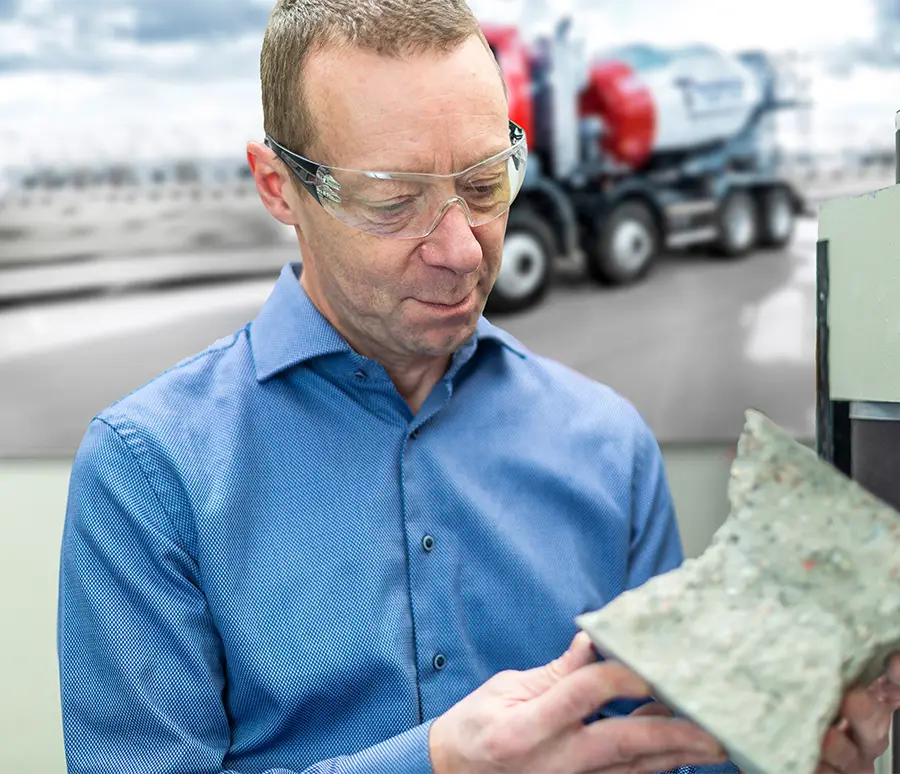
Learn more about new methods for measuring concrete at an early stage, through one of our ongoing research projects developed by Ingemar Löfgren, R&D Manager at Thomas Concrete Group, together with Luping Tang at Chalmers University of Technology.
New methods for measuring concrete at an early stage
How do you really determine when concrete goes from being a workable “loose mass” to a hardened, load‐ bearing material? When you mix fresh concrete, a chemical process called hydration begins. A lot happens in the first few hours: when the cement is mixed with water, ions are released and these react and precipitate as solid minerals, causing the concrete to set and harden. Measuring when and how these processes occur is important because it affects many aspects of the construction process, from how quickly concrete can be processed and surface treated, to the point at which formwork can be removed and how strength is developing.
For cement and mortars, the Vicat test – a mechanical test that shows when the cement begins to stiffen and harden – is used to determine the setting time. In the 1920s, however, scientist Shimizu discovered that this can also be detected by measuring electrical conductivity, which indicates how well the material conducts electricity.
The project has used two different methods, both allowing the concrete to “tell its own story.” This is done by measuring how well it conducts electricity and how much heat is generated, allowing real‐time monitoring of how the material solidifies and gains strength. In simple terms, the conductivity measurement shows how ions are released and how hydration creates a denser structure that reduces conductivity. The second method measures how much heat is generated when reactions occur. Together, they provide a clear picture of each step of the curing process. Two mix designs were tested in the project: one with regular cement and one where half was replaced with blast furnace slag, a residual material with a reduced climate impact.
Positive results
The results showed that the concrete initially had a relatively high conductivity that continued to increase over a couple of hours before reaching a peak, at which point the conductivity decreased, which is a clear sign of curing. The thermal measurements followed the same pattern and confirmed that curing accelerated when conductivity decreased. For the 50 % blast furnace slag mix, the changes were particularly visible, showing that this mix design, which has a reduced climate impact, can also be monitored more closely over time.
The results are important because they help us improve the efficiency of our products, but they can also eventually be used for real‐time monitoring of concrete curing on site. By understanding how different cement types and additives react in real time, we can optimize our mixes and improve control, especially when it comes to developing more sustainable solutions.