Concrete may look like a very simple material – you just mix cement with water, sand, and crushed stone and it will set and become hard. But in reality, it is a very advanced material, and knowledge is required to be able to design concrete for complex construction projects.
At the heart of this material is the calcium silicate hydrate (C-S-H) which is the main binding phase of hydrated cement. The C-S-H has a mineral structure resembling the natural occurring minerals tobermorite and jennite. Knowledge of C-S-H structure is essential as it dictates the shrinkage, creep, porosity, strength and durability of concrete.
From history to the future – knowledge building
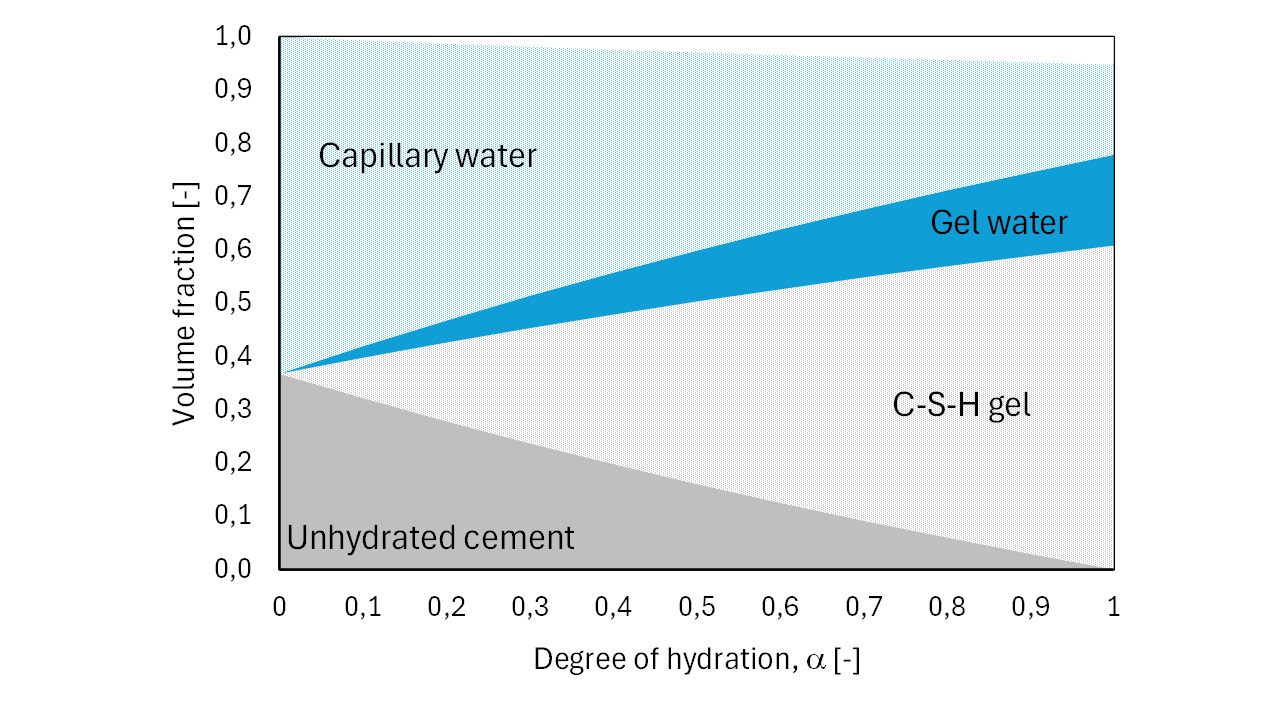
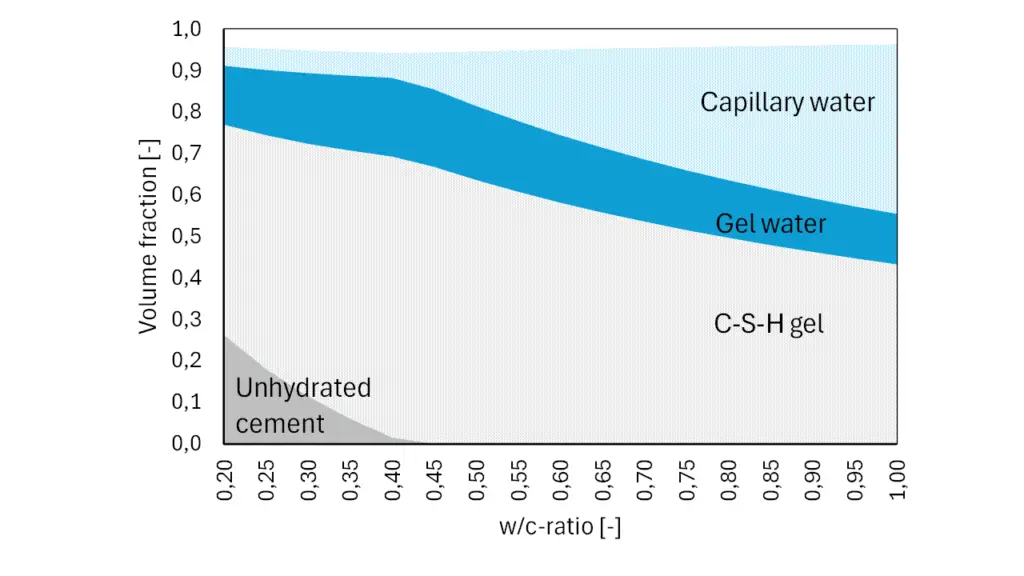
Looking back to the time when Thomas Concrete Group was founded in 1955, this was in the middle of the first “golden era” of cement and concrete science. Less than 50 years prior and 100 years after Joseph Aspdin’s patent for Portland cement, scientists were still arguing about what caused the setting of cement. But, during the 1940s, significant discoveries had been made regarding the complex structure of hydrated cement. T.C. Powers and T.L. Brownyard[1] had established the fundamental relationship between cement hydration, porous structure, and engineering properties. The key findings of this research describe the gel-water (contained in the C-S-H), capillary pores, permeability, shrinkage, and compressive strength, which are essential for predicting concrete durability. Powers models show that hydrated cement has a large porosity, with pores ranging from a few nano meters to 0,1 mm, and one gram of hydrated cement has an internal surface area of about 200 square meters. Even today, the Powers and Brownyard model of hydrated cement is used (se figure 1) and considered as one of the most important contributions in the field.
[2] Powers, T.C., Brownyard, T.L. (1948): Studies of the physical properties of hardened Portland cement paste. Research Laboratories of the Portland Cement Association. Bulletin 22, Chicago.
Figure 1. Development of volume fraction of cement paste as a function of the degree of hydration for OPC at w/c-ratio 0.55 and as a function of w/c-ratio (at =1) – both for sealed curing according to Powers model.
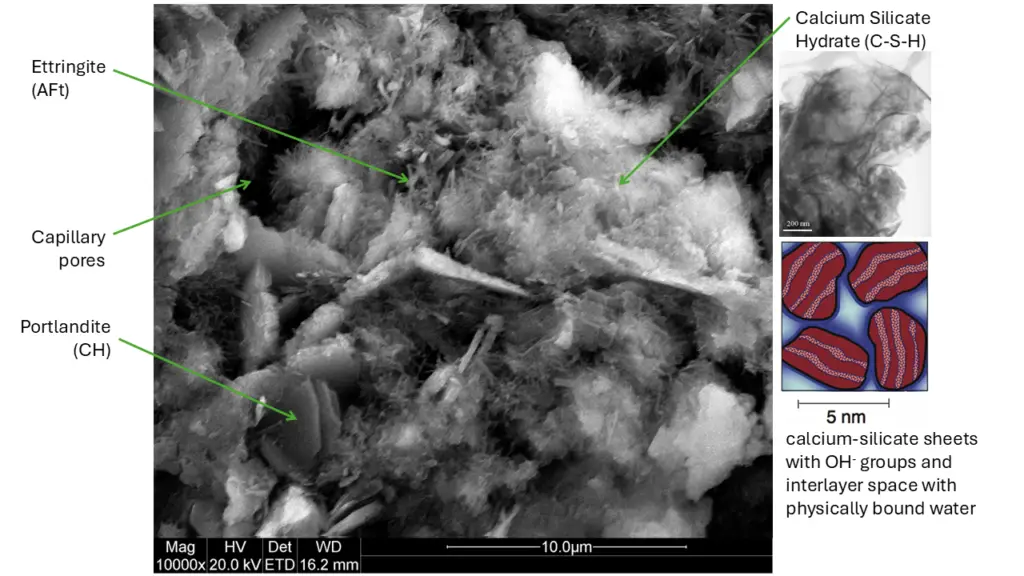
Science have, of course, progressed since then with the aid of more sophisticated and advanced measurement techniques. If you put a piece of concrete under a microscope with a very high magnification, usually SEM/TEM (scanning or transmission electron microscope), enables you to see things that are smaller than a 1/1000 mm and this opens a whole new world (see figure 2). These techniques have enabled researchers to probe the complex nanostructure of C-S-H (figure 2) but also to observe how hydration progresses on nanoscale.
Figure 2. SEM picture of hydrated slag cement paste – 10 µm is roughly the width of a single wool or cotton fiber. SEM picture (left) courtesy of PhD Baodong Li, Chalmers University of Technology.
Future opportunities and challenges
The continuous increased knowledge of this complex material during the 70 years has enabled us, for example, to understand what makes the Roman pozzolanic concrete so durable. But perhaps more intriguing, how we, in a near future, will be able to design and engineer the nanostructure of C-S-H and C-A-S-H (calcium-aluminate silicate hydrate) to achieve certain properties with supplementary cementitious materials and additives to improve volume stability, durability, porosity, and strength. This have been made possible by the increased knowledge and understanding coupled with the development of theoretical models and computer simulations based on thermodynamics and molecular dynamics which have made it possible to model, on an atomistic level, hydration and the C-S-H.
In my mind, there is no doubt that concrete will continue to play a central role in the construction industry, but with a much stronger focus on environmental impact and durability where alternative binders play a crucial role. Research is advancing quickly and with the historic achievements, our amassed knowledge combined with science-based innovations, it will enable us to advance how we are building the sustainable societies of the future. The goal of climate neutrality in concrete production remains ambitious, but thanks to historic and today’s advancements, it is within reach. But industry and society need to increase investments in both basic and applied research to advance innovations and technological developments that are industrial scalable and which actually will make a significant climate impact.