Large volumes of glass are produced worldwide, but not all of it can be recycled into new products. Using ground glass, or as an aggregate, in concrete can extend the material’s lifecycle and create value from a challenging waste stream.
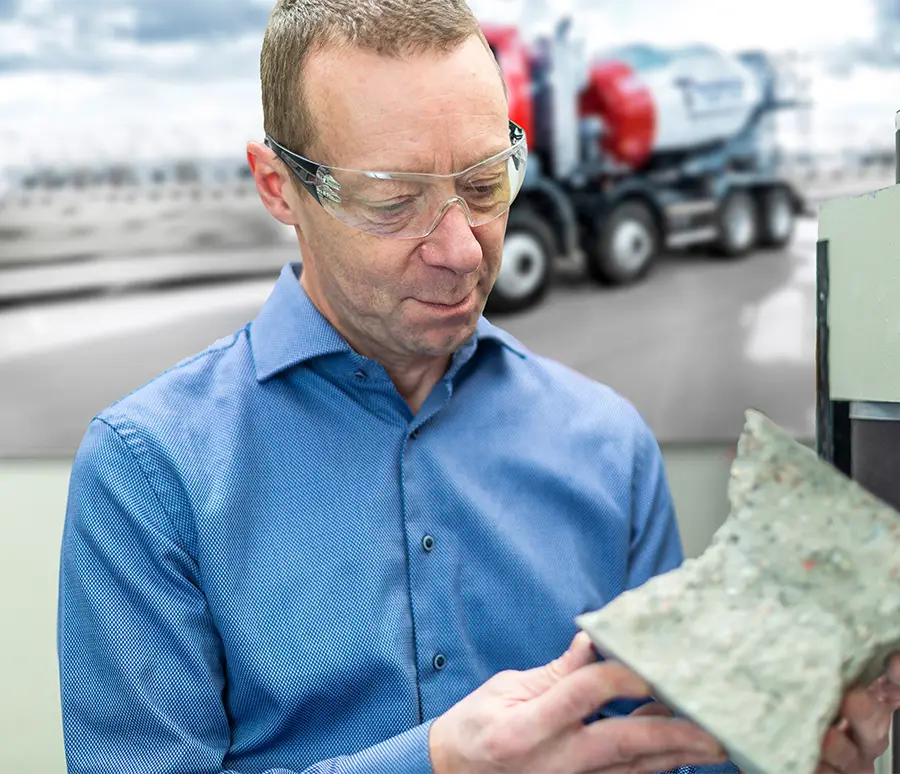
“It is possible to use glass in concrete, but it requires the right application, the right specifications, and above all, control of quality,” says Ingemar Löfgren, R&D Manager at Thomas Concrete Group.
Glass can come from many different sources and vary in composition, which means its performance can also vary, but to use it in concrete, the material must be predictable. Achieving consistent, stable quality is consequently one of the main challenges. Another key question is how the glass powder behaves in the mix, in some cases it can act as an active binder (a pozzolan) and contribute to hardening over time, while in others it mainly serves as a filler.
Different levels of progress
In the United States, a standard for glass powder as a pozzolanic material for concrete (ASTM C1866/C1866M) shows that the material is moving from experimentation toward broader use. A major challenge, however, remains finding suppliers that can deliver a homogeneous product with stable quality.
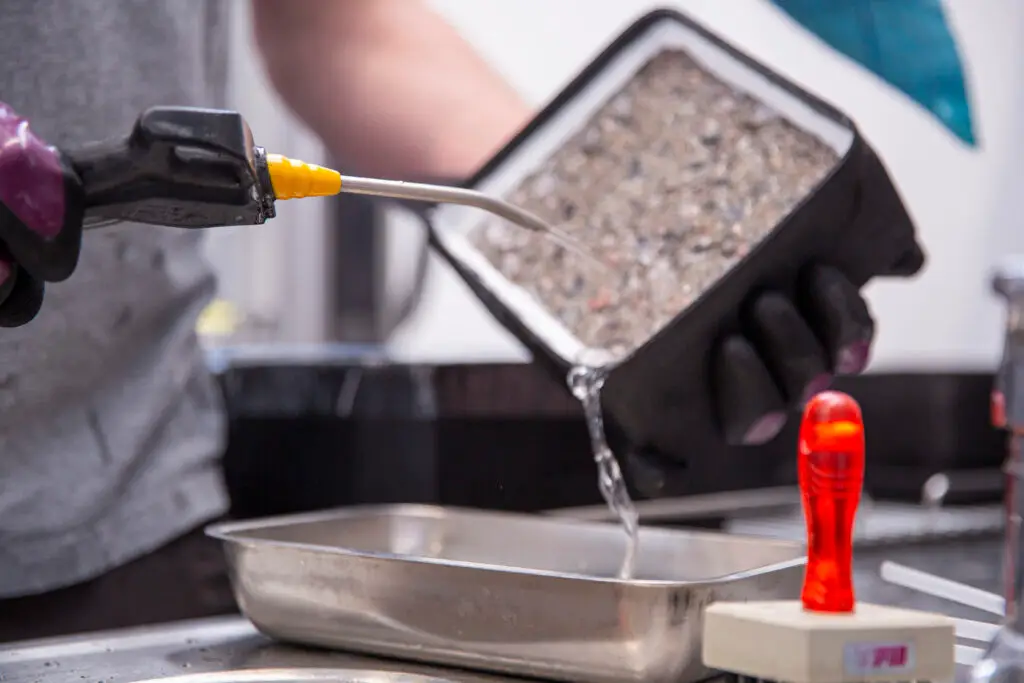
In Poland, we are exploring replacing part of Portland cement with residual materials from other industries. Our team is now evaluating glass powder from car windshields as a potential binder component. The material is currently being tested in the lab, with results expected after 28 and 90 days to determine whether it can function as an active binder or mainly serves as an additive. Next, we will test it in concrete to identify the best dosage and use.
Early tests in Sweden
In Sweden, glass powder in concrete was tested 25 years ago in a project initiated by Swedish Glass Recycling. The focus was not a binder, but a filler material for self-compacting concrete. The material performed well and was used for a period. However, scaling requires a stable input stream and consistent product quality, an issue seen in Sweden as well as in the United States, where incoming recycling streams can vary.
Other ways of using glass
Glass can also be used as aggregate in decorative concrete, such as terrazzo. One example is the terrazzo in Liljeholmen station in Stockholm, where glass creates a distinctive visual effect. However, glass contains both silica and alkalis, and in humid environments it can contribute to unwanted reactions and expansion. For that reason, it is best suited to indoor environments, and material choices should be assessed based on where the structure will be used.
What the future holds for glass powder remains to be seen, but our work continues to make better use of available resources and further reduce the climate impact within the industry.