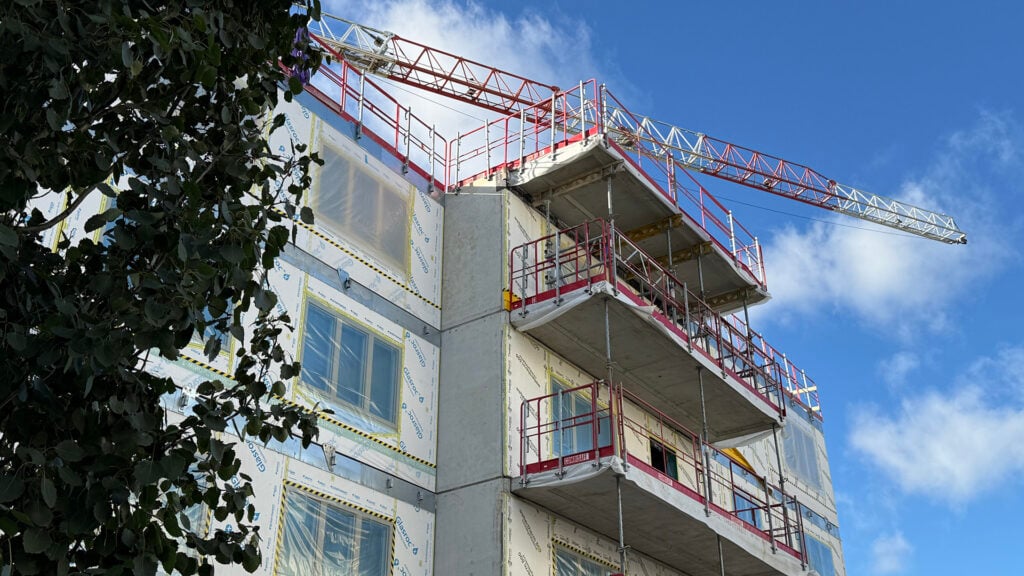
Read about the collaboration between NCC and Thomas Betong.
Concrete is the most widely used construction material in the world, and cement accounts for around 90 percent of its climate impact. That is why reducing the amount of cement is crucial, without compromising function or performance.
“The largest and most important measure to reduce the construction sector’s climate impact is to use low-carbon concrete, where cement is replaced with alternative binders,” says Karin Gäbel, Chief Sustainability Officer at Thomas Concrete Group, which includes Thomas Betong.
Concrete is needed to build the sustainable societies of the future.

Optimize the material instead of replacing It
NCC is working toward climate neutrality by 2045. Reaching that goal does not require replacing concrete as a building material but using it more efficiently.
“NCC is material-neutral and we have no incentives to use one material more than another. But concrete is important to us. We cannot believe that the material can simply be replaced, since it is a key component in all our projects. To reduce the climate impact of our projects, it is our responsibility to minimize the climate impact of the concrete we use,” says Nilla Olsson, PhD, Technical Specialist in Building Materials at NCC.
For Thomas Betong, early involvement in projects is crucial to reaching the goal of being climate-neutral by 2045.
“As a material supplier, we have often been brought in late in the process. It is when we, as concrete specialists, are involved early that we can make the greatest difference for the climate. That is when we can use our expertise to develop new mix-designs and adjust all parameters to optimize our products and solutions,” says Karin Gäbel.

High climate requirements led to new ways of working
The Takryttaren residential project in Uppsala, Sweden, includes 174 rental apartments, 70 shared living units, and an LSS housing facility, and is being built by NCC. The client, Uppsalahem, set a climate budget early on, which became a key driver for testing and developing new solutions and ways of collaborating.
NCC worked consistently with structural optimization to reduce the amount of material used. At the same time, Thomas Betong developed products with significantly lower climate impact.
“The low-carbon products used in the project include precast floor slabs with 50 percent lower climate impact, as well as sandwich walls and low-carbon ready-mixed concrete with up to 60 percent lower climate impact. In addition, our design department invested significant resources in reducing both the amount of concrete and reinforcement in the precast elements,” says Karin Gäbel.
The project has become a test bed for a new generation of products with much higher substitution levels and therefore a lower climate footprint than previously possible. These levels are not included in the Swedish Concrete Association’s guidance for low-carbon concrete, which currently extends to level 4, corresponding to a 40 percent reduction compared with the industry reference.
From theoretical calculations to practical results
The foundation for the work behind Takryttaren lies in an independent theoretical study conducted by IVL Swedish Environmental Research Institute. The study showed that low-carbon concrete combined with semi-precast solutions can meet the requirements for halved climate impact.
The study marked the start of a more systematic effort, where NCC and Thomas Betong jointly searched for a project in which the theory could be fully tested in practice. Takryttaren ultimately became that opportunity.
“The IVL report published in 2023 showed that our low-carbon precast concrete elements, together with the low-carbon concrete Thomagrön, meet the requirements for halving climate impact. The report also pointed to additional potential if, for example, the structure were optimized. Since the report was published, we worked intensively to find projects where the theory could be put into practice,” says Karin Gäbel.
When the Takryttaren project became relevant, the conditions were finally in place to test this approach fully. Takryttaren therefore became the first project where the theoretical potential could become reality. The results exceeded expectations.
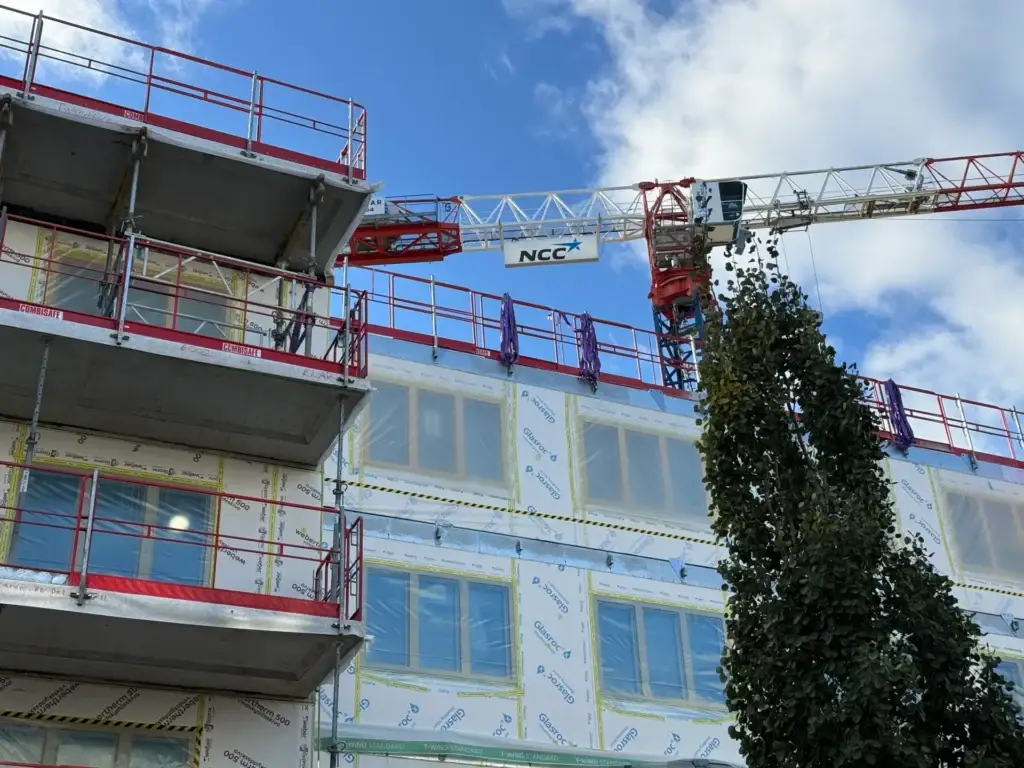
Three principles that delivered the greatest climate benefits
Three clear principles emerged from the work on Takryttaren. These principles guided the project from start to finish and are also simple enough to be applied in almost all future projects.
- The right concrete in the right place
Do not use higher strength and exposure classes than necessary. This creates room for lower cement content and more low-carbon binders without compromising function or service life. - Structural and reinforcement optimization
Streamline solutions without weakening acoustic or functional requirements. In many cases, slightly more concrete with less reinforcement is both more cost-effective and better for the climate. - Low-carbon concrete
Optimize concrete mix-designs and replace part of the cement with alternative binders. This makes it possible to significantly reduce climate impact.
“We are talking about being efficient with the resources we have. Resource efficiency also means moving toward lower strength classes and lower cement content. Less cement and more alternative binders. That is where the future potential lies,” says Karin Gäbel.
NCC reaches the same conclusion. For a long time, development has moved toward increasingly higher strength classes, which is not optimal from a climate perspective.
“For a long time, market development in residential construction has driven choices toward higher strength classes. These were rational decisions based on production pace, drying time, and cost efficiency at the time. At the same time, higher strength often means higher cement content, which results in greater climate impact. Now that climate considerations carry more weight, we need to question these choices more thoroughly and ensure that the right concrete is used in the right place,” says Nilla Olsson.
From pilot project to a new industry standard
The lessons learned from the Takryttaren project are many. What was once seen as an advanced pilot project is now a clear and scalable working model, with closer collaboration, new roles, processes, principles, and technical solutions that can be applied in the next project.
“In Takryttaren, collaboration around concrete has been closer and more structured than in many previous projects, which required time to clarify roles and ways of working. Going into the next project, we bring clear lessons and a better understanding of how, based on customer requirements, we can minimize climate impact while ensuring cost efficiency. We clearly see how resource-efficient solutions emerge when early project decisions are combined with close collaboration with the material supplier,” says Nilla Olsson.
“Takryttaren is a pilot project where we have adjusted every parameter. Now we need to scale up and bring this type of collaboration into more projects, so that together with contractors and clients we can reduce the climate impact of construction as much as possible. Early-stage collaboration combined with low-carbon concrete is a natural part of the future of construction,” concludes Karin Gäbel.